Tuesday, June 18, 2013

Singles Scene #17 - Aberfoyle Market


Rain, a lot of rain. It was raining and the wife and I popped out on a Sunday morning to the Aberfoyle Antique Market looking for a knick-knack that would look good on the corner of our deck. We found it, and old wood stove, and the Mrs. was running to the bank machine to get the money. But, it was raining. So instead of going with her, I wandered to the stall next door, which had records dangerously close to getting wet.

The albums were the usual lot of common stuff, things that as a long time record collector I either already had, or had long ago determined I didn’t want. But beside the albums, in four whole rows, singles! Hundreds of them, nicely stacked in the vertical for ease of flip-through. Haven’t bought some Canadian in while, I thought, and quickly hit BTO’s My Wheels Won’t Turn. Game on, and since I was picking up some Canadian anyway, I grabbed a few others: Mull of Kintyre; Rod Stewart’s Jeff Beck reunion, People Get Ready; ELO’s Telephone Line; Robert Plant’s Little by Little. Then I hit on something, Led Zeppelin’s Immigrant Song with Hey Hey What Can I Do on the flip. My heart skipped a beat: could it be my personal holy grail, a 1970 original of this very, very hard to find single? I have an early 80’s re-release, but this is different: the Red Atlantic label instead of Gold, first initials on song writing credit, no mention of previous release. Could it be? It may be, holy s@$t it might just be. 


Now I’m in, and I’m screaming for the wife to hand me cash while I hunt for just one more piece of Canadiana. It turns up in the form of something I love, Dan Hill’s Sometimes When We Touch, with the gorgeous Still Not Used To on side B. I look for the vendor, who picks through my pile, says $2.00 a record, which I might normally balk at if I didn’t have a possible gem, the single I have searched for since the late 1970’s, in the pile. He never noticed any possible value in the stack, but not wanting to appear like an easy mark, I offer him $10 for the pile, which he happily takes.

My Wheels Won’t Turn is the lead single of BTO’s 1977 album Freeways. By 1977, BTO had peaked, both musically and in popularity, and Freeways, while by no means a bad album, doesn’t match up to their earlier work.  My Wheels Won't Turn carries the grit of the best BTO material,  but lacks the melodic sensibility that took BTO beyond a mere hard rock band. Randy Bachman's singing, as well, lacks melody and enthusiasm. 

Dan Hill's Sometimes When We Touch  is such a well known piece there is probably not much point in reviewing it. It is a sappy bit of tripe, a love it or hate it song. As pointed out when I reviewed Hill's album, Longer Fuse, I love it, mostly because it found me when I was most susceptible to such a song, i.e. after I discovered music, before I discovered Led Zeppelin. It is worth noting, however, that unlike a lot of sappy pop songs through the years, it really is a well crafted composition.

The flip side of Sometimes When We Touch is my favorite Dan Hill song. Still Not Used To is the kind of song Hill does best. Acoustic guitar, his wonderfully expressive voice and a song that is both poignantly personal and self-effacing. Examining his then burgeoning career and how he feels about it,  Still Not Used To explores an artist having success and wondering how or why:

Still not used to having people, pay to hear me.Guess I'm still a child, tryin' so hard to please,tryin' to seek approval through my songs...

After this single, a lot more people paid to hear Dan Hill, he found a lot more approval for his songs. It was a life changing single, and giving both sides a hearing it's easy enough to understand why.

Sitting on the deck, typing beside the wood stove, Led Zeppelin's Hey Hey What Can I Do just finished and Dan Hill's Still Not Used To about to come on, I'd have to say it was a Sunday morning well spent.

Monday, January 10, 2011

Singles Scene #16: Brantford

I’m driving out to Brantford with a purpose: I’m looking for an 8-track player. A couple of years ago I was at the Cross Roads Trading Post, a great junk market in Brantford. It was easy to find the first time, and I’ve even been back, so a quick trip in and out and I should be good.

Two hours later, I haven’t a clue where this place is, can’t remember what it’s called and have about an hour left before the stores start closing down on this Sunday afternoon. My wife called to ask me to pick up milk, and I mention I haven’t a clue where I‘m supposed to be. She pulls out The Wayback Times and gave me an address in about thirty seconds. It’s a Bingo, and I arrive at the Trading Post just after 4:00.

The Crossroads Trading Post is a one storied, horseshoe shaped building with a plane on the roof, an outdoor market in the courtyard, and a mass of electronics, furniture, old phones and assorted antique/collectible/junk. It may be January, but the outdoor stalls are still full of old tools and household items. I move around it quickly, find no 8-track player and get inside opting not to, in Ebeneezer Scrooge‘s words, “conduct my affairs in the teeth of inclement weather.”

Inside I find a few spots that are promising, including literally a stack of electronics at the back. In the quadraphonic pile-up, a couple of old stereo systems with built in 8-tracks. It’s not what I’m looking for: either a stand-alone unit or a smaller component. As tempting as it is to re-buy my first stereo, a Lloyd's unit with turntable AM/FM radio and 8-track player/recorder, it‘s not what I need. There is one, a small unit, with built in radio, but it is outside of my price range and I’m not willing to move on the budget I gave myself.

I may have crapped out on the 8-track player, but around the corner and two stalls away from my first stereo lies a box of singles. If I can’t get what I want, I‘ll take what I need.

There’s a couple of hundred here, not sorted, at $1/per. The range is varied, from Stealers Wheel’s Stuck in the Middle to Joe Dolce’s Shaddap You Face. Picking through it, I buy a couple of non-Canadian’s: Bob Seger’s Old Time Rock and Roll and, believe it or not, Captain and Tennille’s Love Will Keep Us Together (one day I’ll have the coolest jukebox). Somewhere between Dolce, Joe and Seger, Bob, was a couple of pieces of Canadiana.

Besides some local stuff, Celebrating Brantford sort of thing, I find four Canadian singles: Prism’s Young and Restless, Gino Vannelli’s Black Cars, Dan Hill’s Can’t We Try and the obscure title of the day, Kitchener’s Charity Brown’s You Beat Me To The Punch.

Raised in Kitchener, Charity Brown returned last year during the Kitchener Blues Festival to a full and enthusiastic crowd. Singing blues songs now, in the 70’s she was doing contemporary pop, with pictures of a very, very cute Charity Brown staring out from the album covers. The song she is most known for is Take Me In You Arms, which sadly, I didn’t find.

What I got was has her second single, You Beat Me To The Punch on side one, and side two has her first single, Jimmy Mack. You Beat Me To The Punch is on old Smokey Robinson song, and has all the earmarks, and sound of a pre-Beatles rock and roll song. It’s alright, but out of place as a 70’s pop hit. The other single, the old Martha and the Vandellas song, Jimmy Mack, works much better. It is still a Motown song, and Brown has a clean, clear voice that handles the song beautifully. The sort of thing you could play at a dance or party and get away with it.

Dan Hill, on the other hand, your not playing at too many parties, and at dances only to get the couples snuggling. Can’t We Try was a 1987 release, ten years after “that” Dan Hill song. What’s surprising is it’s a duet with Vonda Shepard, who would earn fame in the 90’s as the singer at Ally McBeal’s favourite drinking spot. It is a reasonably standard Dan Hill ballad: the duet format works and it is a pretty song.

Prism Young and Restless is a more known entity, and I like both this band and song. Regardless of their overly 80’s keyboard, Prism always had a strong pop sensibility with a solid rock edge. It’s been a while since I heard this song, and I enjoy it. The b/side, Deception, is more of a rocker is a pretty good song.

Last up is Gino Vanelli. By 1986, Montréaler Vannelli had been a been recording for over ten years. He had early success in the United States, particularly Grammy nominated song I Just Wanna Stop. Black Cars was a phenomenally successful song for Vannelli, but it must be said, I never liked it. This kind of 80’s electronic/keyboard music was never to my taste, and listening now I still only got halfway through the song. Black Cars is, for better or worse exactly what you remember it to be. For me, that for the worst.

As I drive away, not in a Black Car, from Brantford, four Canadian songs (plus two non-Canadian) to the better and $6.00 to the worst, I’m feeling pretty good. The Charity Brown, The Prism and maybe even the Dan Hill will get played again. Black Car, on the other hand, only comes out on 80’s night, which may never come.


Saturday, September 11, 2010

Review: Bachman & Turner

When Randy Bachman decided to record a solo album with guest singers, one of his first calls was to his old Bachman-Turner Overdrive (BTO) partner C.F. (call me Fred) Turner. The two got together and recorded Rock and Roll is the Only Way Out. The results so pleased them that Bachman shelved the solo album and BTO was reborn. Except, Robbie Bachman and - how was this allowed to happen? - Blair Thornton objected to the use of the name and sued (Thornton is often erroneously referred to in media reports of this as “an original member“). So Bachman & Turner was born.bachmanturner

“…people are saying this album sounds like it was supposed to be released in 1977,” Bachman has said of Bachman & Turner, the new album that was released Tuesday. “That’s what I was trying for. People… don’t want… Fred doing a rap/hip-hop kind of thing.”

There’s a lot in that statement, not the least is that the album sounds like 1977, when BTO was on the down side, instead of 1974, the middle year of their three best albums. In 1973 BTO released their very good, but rough debut album, followed the same year by their breakthrough Bachman-Turner Overdrive II. In that one year Blue Collar, Takin’ Care of Business and Let it Ride were written, recorded and released. The next year they replaced the third Bachman, Tim, with Thornton and released Not Fragile. Roll On Down the Highway, You Ain’t Seen Nothin Yet and Rock is My Life were on that album. In 1975, it was Four Wheel Drive, and Head On, adding the title track, Hey You, Take it Like a Man and Lookin’ Out for #1 to the canon. Other than the 1976 single, Down to the Line, that was pretty much BTO. Saying Bachman-Turner sounds like 1977, then, is a back-handed compliment.

Yet it’s also accurate. After Four Wheel Drive, something changed in the BTO sound. They approached melody different, the guitar took on a new tone. The difference was there, hard to define, but they weren’t the same band that recorded Takin’ Care of Business. So it is with the new album. It is loaded with good songs, bereft of great ones.

The album is often hard rocking as Can’t Go Back to Memphis, I’ve Seen The Light and the above mentioned Rock and Roll is the Only Way Out remind one of that old BTO adage, “you ask do we play heavy music, well are thunderheads just another cloud?”

Can’t Go Back to Memphis, however, suffers from vocals that are run through what sounds like an old blues harp microphone. I’ve Seen the Light as well as Moonlight Rider and Rollin’ Along all benefit from Turner dropping his Fred persona and singing like C.F. Turner of old. So much so that Moonlight Rider and Rollin’ Along are the albums best songs.

Rollin’ Aling, was in fact pre-released as a single. It is the albums signature piece and, as Fred Turner said of it, the continuation of Roll On Down the Highway. That’s a fair description and it is as enjoyable a song.

Moonlight Rider, on the other hand, is Turning Japanese meets The Letter. The opening is reminiscent of Turning Japanese‘s signature lick, but the song melodically is The Letter to a tee. The two combine to make a great rock and roll song.

According to a CTV report, “an early listener… told Bachman… Find Some Love, was ‘the greatest Led Zeppelin song since Led Zeppelin.’” It’s true too, it is eerily familiar to when Zeppelin covered Harlequin’s I Did it For Love… No, wait, that can’t be right. Find Some Love doesn’t bear superficial comparison to Led Zeppelin, but again, that doesn’t mean it’s a bad song. It is a hard rockin’ guitar song with the soul of a pop song, very reminiscent of fellow CanCon rockers Harlequin. Slave to the Rhythm is in a similar vein, a pop song dressed up as a rocker.

BTO wasn’t one for ballads, at least not in the traditional sense. When they slowed it down, Bachman’s jazz sensibilities emerged, and some real gems that combined a jazz feel and harmonic structure with a slow rock beat produced some of BTO’s best songs. On this disc the role falls to Traffic Jam. As nice harmonically as Blue Collar or Lookin’ Out for #1, melodically it is not as consistent, and because of this doesn’t work as well as the those earlier pieces.

While there is much good in the new Bachman-Turner album, it is not flawless. If you wrote a 70’s sitcom called That’s What It Is, then Bachman & Turner have a theme song for you. That’s What It Is is bad disco, done by guys who obviously don’t get disco. Try the Theme from Rocky (Gonna Fly Now) meets the barf bucket and your close. Repo Man is of another category of bad: boring and dumb. Waiting Game features a lousy vocal performance by Bachman, and Neutral Zone is just that, blasé and neutral. It’s not that it’s a bad song, but when was the last time you listened to “that song that didn’t bother you that much?”

Bachman-Turner is a good, not great album by a couple of guys well past their prime who have found a way to tap into that prime and come close. By 1977 standards, it’s an OK rock album. But today’s, it’s far above average.


Tracklist:

1. Rollin' Along
2. That's What It Is
3.Moonlight Rider
4. Find Some Love
5. Slave To The Rhythm
6. Waiting Game
7. I've Seen The Light
8. Can't Go Back To Memphis
9. Rock 'N' Roll Is The Only Way Out
10. Neutral Zone
11. Traffic Jam
12.Repo Man

Saturday, September 04, 2010

Singles Scene #15

Waterford: I talk a lot about Vinyl. The glory of the black plastic, spinning away at such or another speed, creating marvellous, analog music. Magic. img040But part of the fun of records was they didn’t have to be made of vinyl. You could, and they did, cut the grooves into a thick piece of paper, protect it with lacquer and it would work. It would suck, quality wise, but it worked. You could put a record in the cereal box, or McDonalds could give out Alf records on their happy meal box.

Waterford is in South-West Ontario, one of those towns that dots the area West of Brantford South of London between Lake Erie and Lake Michigan. It’s tiny with two beautiful old churches and a one block downtown. Alice Street runs off the downtown, along the waterfront, and in a big old warehouse on Alice is the Waterford Antique Market. It’s a standard antique market, with multiple vendors selling various pieces of old junk: furniture, phones, books &tc. Waterford Antique Market is actually fairly large for the size of the town it’s in. Of course, it’s got records.

LP’s there’s always LP‘s, and lots of them. But they also have a nice collection of 45’s. Among them, an odd shaped cardboard recording of The Greater Evangelistic Crusade of Toronto (from the Billy Graham team) from 1955. It appears to commemorate their CNE crusade from that year, including a picture of a packed grandstand. I have little interest in the music, but it’s a gem from a collectible standpoint. As well, there was a 45 of the National Anthem, an “extraordinary recording [that] was made especially for the 1976 Olympic Games and via satellite broadcast was heard by more than two billion people around the world.” Complete with gate-fold 45 cover and pull out picture collage. Again, a nice piece for a Canadian music collector. On top of those two, a few others were amongst the pieces: April Wine’s Just Between You and Me; Alannah Myles’ Love is; Rock and Hyde’s I Will.

img041Sadly, as happens at these stores, prices are affixed to the records with stickers. In some cases, right on the playable part of the record. Granted, the records were only $1.00, but slapping a sticker on them does harm. The stickering massacre includes the cardboard Greater Evangelistic Crusade recording and the sticker which is not coming off without damaging the record itself. Fortunately, everything was ½ off when I got to the counter, which means my $7.00 worth of records (I picked up a couple of non-Canadians) was obtained for $3.50.

On further review: the cardboard record works, but it is, in fact, a 78. I don’t have the capability (actually, not true. I have a new USB turntable that, supposedly, has the ability to record a 78 at 45RPM and speed it up. I have no idea how, though).

Oh Canada comes in Instrumental, English, French and Bilingual versions. It’s a pretty standard, end of the broadcast day version, and I have heard it innumerable times. If I ever get an ice rink in my back yard again, and get some hockey going, there is no need to invite The Nylons to sing - we have an anthem. Otherwise, this will likely sit in my collection unused.

Rock and Hyde were Bob Rock and Paul Hyde, the soul of the Payola$, post Payola$. One of my favourite albums of the time, the time being 1987. It’s easy to remember why. I Will is the second single on the album, the stunning Dirty Water being the first and better received. But this is good, up tempo pop song. Lots of 80’s style keyboards, but Bob Rock went on to be a metal producer, and it has that bit of an edge.

img039The b side, What Children Say, is different. Keyboard used to create a different sound, and typically bright lyrics, I like this a lot after not hearing it for years. Sadly, the record itself is not in good shape. It is warped heavily, causing the needle to wobble around. The sound however, does not seem affected, and it’s a wonderful listen.

I was a big April Wine fan in 1981 when Nature of the Beast came out. Just Between You and Me is very familiar to me as a song I heard a million times, but also as a song I heard on the radio yesterday. No surprise here. By 1981 April Wine had figured out their sound. It was layered, clean and polished. They were pros, and this is a good example of everything that was good, very good about April Wine, but also everything that was wrong with them. It’s a nice guitar ballad, with solid musicianship, good tune, nice lyrics, what can be wrong. Yet at the end of the day, it’s a little too polished. A mistake, a wrong note wouldn’t hurt.


Big City Girls is the other side of April Wine. An up tempo rocker with a boogie rhythm and lyrics suggest something or another of sex. I saw these guys live a number of times in this era, and they were always a fun band. This is one of those fun songs, and listening to it now I can see Brian Greenway and Jerry Moffat bouncing on the drum risers to it.

Love Is was Alannah Myles first single of her debut album. I remember this album well, and even played this song in a band at one time. It is a good solid rocker, complete with great lick, thick bass drum driving the rhythm, and a chick that can flat our sing. The complaint stands that the album, and song, may be overproduced, but 21 years later, Love Is still sounds pretty good.

Another up-tempo number, Rock This Joint is weaker, but not a lot so. On an album that featured Love is, Lover of Mine, Still Got This Thing and the spine chilling Black Velvet, Rock This Joint suffers by comparison. But for a lot of other artists, a lot of other albums, this may have been a hit.

A guy walks into an antique warehouse in the middle of nowhere, and comes out the other end with 3 good rockers, that all have pretty good b sides, plus a national anthem and a Billy Graham cardboard 78 for less than 5 bucks. A good haul, a good day topped off with a good listen.

Sunday, December 27, 2009

Milk Crate Classic #7: April Wine - Stand Back

Ever since the idea of the Milk Crate Classics was allocated to me I knew that sooner or later, I would cover April Wine. From day one, the question I have rolled in my mind is "Stand Back" or "The Whole Worlds Goin' Crazy"? These two albums always stand side by side in my memory, and they have these past six months while I mentally debated the relative merits of covering each. I had reached a tentative decision with myself whenaprilwine13 I decided to listen to the album of choice: "The Whole Worlds Goin' Crazy". One side of the album was all I needed to change my mind. "The Whole Worlds Goin' Crazy" is so unbelievably dated and, I hate to say it, mediocre. What was one of my all time favourites came crashing down around more mature sensibilities.

"Stand Back" was April Wine's fourth album (fifth if you include the live album), and the first completely free of the founding Henman brothers. It was a springboard to some moderate success that would come in the mid seventies, notably with "The Whole Worlds Goin Crazy" and "First Glance." Yet I always thought it a bit of a second rate album, the one that wouldn't stand up over time. And that annoying song Oowatanite, who would listen to that in 30 years time? So 30 years later when I hear April Wine on the radio, why is it always that song? If not that, then Tonight is A Wonderful Time To Fall in Love or the ballad I Wouldn't Want To Lose Your Love. I would never have dreamed that I Wouldn't Want To Lose Your Love would sound better than Crazy's Like A Lover, Like A Song; the latter always seemed so much deeper. I realized some years ago that deep in pop music usually means piled higher, and Like A Lover, Like A Song is no exception. How could such a notable know-it-all be so wrong? I'm still not sure, maybe "Stand Back" was difficult to digest then because it wasn't as trendy. The music had much more merit in it's own right than other, more timely albums from Canada's Spinal Tap.

aprilwine12Going through the album, most of the songs are good in their own way. Oowatanite is, it turns out, just a great rocker. It affords an early glimpse at the stadium rock-stars that April Wine eventually became. It's worth noting that when April Wine was selling out the C.N.E. Grandstand every August, this was the opener. Great way to start a concert and a great way to start an album. Victim of Your Love, Baby Don't Got Some Soul and Tonight is A Wonderful Time to Fall in Love all hold up well over time. Some old favorites still sparkle, as well. Cum Hear the Band was always a song I enjoyed, and it's still a nice song. One of my all time April Wine favorites comes from this album, as well: Not for You, Not for Rock and Roll is still what it advertises, a good, straight ahead rock and roll song.

All the joy at discovering this long lost classic aside, "Stand Back" has always had it's weak moments, and still does. Sloe Poke is still a lame attempt to sex up the album (as is the spelling on Cum Hear the Band) and Wouldn't Want Your Love (Any Other Way) is a little too pop for even my tastes. As well, I have never got Highway Hard Run, and I still don't. Don't get me wrong, I'm not one of those tripe heads who think rock and roll songs should say something or mean something - Barney Bentall can leave Jelly Roll just as it is and I won't mind. But Highway Hard Run seems to be attempting something and, I think, fails miserably. It is just not a very good song. However, the song truly deserving of never being played again is Don't Push Me Around. I used to think this was a good song, many probably did. But the chorus must be re-heard to be believed:

            Hey man I said don't push me around.
            Hey man I'm 18 and I've been around.

As well, such truly charming lines as

            I've got an old Cadillac
            I like to sit in the back
            and flog the dog between the covers of sex-teen.

"Stand Back" is a good, not great, old album. April Wine was still five years away from becoming one of the biggest rock bands in the world, but "Stand Back" was a prelude to what was coming. The sign of what was to come was there for all to see, and I have finally seen it.


Monday, April 20, 2009

The Singles Scene #14

Freelton: Freelton sits on highway 6, approximately 6 KM south of Guelph. It is one of those "if you blink you miss it kind of towns," particularly as the highway runs past the edge of it, not through it. But if you get off at Freelton Road, you quickly find yourself at a pair of old barns. Inside those barns: treasure.

The Freelton Antique Mall is one of those a little bit of everything places, and should really have the word "Collectibles" somewhere in it's title. Today's mission: find an antique rod iron lamp for the Mrs. and an old dial phone for my office. We had great success on the lamp, but I couldn't find a phone in black at a price I like (now of I wanted a turquoise or avocado phone, those they have... cheap). Secondary to those silly trinkets, my eyes are always open for records, and of course, 45's.

The Freelton Market has two barns. The main one if stuffed with goodies, separate vendors have booths and you pay at the main counter. The second barn is more open, has less vendors, and the vendors are right there taking you cash.  It is in this second barn that I find some old 45's.

They have a few hundred - 60's and 70's mostly. After pulling through the top box, the vendor pointed out their was more below, but I had my haul. At 50c each, I grabbed eight records, four of which are Canadian: Prism's Take Me Away; Loverboy's The Kid is Hot Tonight; Ian Thomas' Pilot and Dan Hill's All I See is Your Face.

I've always liked Prism, ever since their first single, 1977's Spaceship Superstar.img024 Take Me Away is from a year later and Prisms second album, the always seemed to be there See Forever Eyes.  Prism rode the sweet pure voice of Ron Tabak and the keyboard/guitar pop sensibilities of Lindsay Mitchell and John Hall to worldwide acclaim with a series of radio friendly songs and albums. Four albums in three years to be exact. There fifth single, Take Me Away, comes in year two and is classic Prism. That soaring voice, clean sound and pop back beat (that's  Bryan Adam's writing foil Jim Vallance on drums) leave you feeling good and with the melody stuck in your head.

Local boy Ian Thomas, and brother of SCTV's Dave Thomas, has a writing credit biography that would please the most ambitious of songwriters, including one of my all time favourites, Right Before Your Eyes.  With a discography that includes Painted Ladies, Coming Home and The Runner, Pilot, the opening song from 1979's Glider is one of his weaker efforts.  Taken in isolation, however, Pilot is not a bad song. It has a disco, funk, jazzy groove that people like the Michael McDonald led Doobie Brothers were having success with at the time. It suffers from a weak keyboard sound, not unpopular at the time but is still a listenable and solid contribution to Thomas' discography.

Loverboy is the official punchline to many Canadian music jokes these days, but people forget how they stormed onto the scene in the summer of 1980. Their debut img023self titled album was the hot album that year on the back of two huge singles, Turn Me Loose and The Kid is Hot Tonight.  The remarkable thing about this inaugural single is it has both songs on it. Keyboards were a hot item in 1980, and Loverboy brought it immediately with a keyboard introduction that segued into a great bass groove before Paul Dean's guitar came in loud and heavy, in case anyone thought this was going to be another soft new wave band.  They weren't and at seventeen, I never again roller skated without this song being played.img022

The flip side is single number two, The Kid is Hot Tonight. It's hard to say why Loverboy became a punchline: it could be Mike Reno's weight gain in the 90's; possibly the red leather pants they became synonymous with; perhaps it's the formulaic songs. As to the latter point, The Kid is Hot Tonight plays right onto the formula established in Turn Me Loose: heavy guitar, thick bass and lots of keyboards. Once again, it works, and works really well. Perhaps it's because I was seventeen in the summer of 1980, but listening now I don't hear the joke. This is solid, good rock 'n' roll and I have no complaints against it.

Dan Hill seems to be getting a fair shake on this blog lately. This is not intentional, sometimes things just run in streaks. All I See is Your Face had the impossible task of following up Hill's greatest hit, Sometimes When We Touch. Off the follow up album Frozen in the Night, All I See is Your Face is another pretty song that is recognizably Hill, without being a copycat of it's predecessor. Surprisingly, the b/ side is, again, a future single - with Hill's second biggest hit, Let The Song Last Forever, sandwiched in between them.  Dark Side of Atlanta is a more poignantly personal piece that is familiar to Hill fans. Told in story form, it captures Hill at his songwriting, if not his commercial best. Less familiar, a harder song than All I See is Your Face, it is, however, more worthwhile. Another single I'm glad I bought, but really for the b/ side.


No surprises today, I grew up with all these songs and they all hold up in my memory. Nothing here is outstanding, but if your a pop music fan, or a fan of the late 70's early 80's music, then four good singles. If only I could have found that 70's phone to go along  with them.

Friday, February 27, 2009

CD Review: Stephen Fearing - The Man Who Married Music: The Best of Stephen Fearing

It was the late 90's, around the time of his first album Industrial Lullaby,  that I first heard Stephen Fearing. He was on TV,  TVO's In Studio if memory serves me correctly. His playing was virtually classical, with two and three separate lines of music weaving across his finger picked guitar. Yet unlike any classical player I had ever seen, he was singing as well as playing this complex music. I've been a fan since.


[caption id="attachment_121" align="alignright" width="300" caption="The Best of Stephen Fearing"]The Best of Stephen Fearing[/caption]

I saw him live once, in one of the most amazing shows I have ever been to. It was in a music store in Fearing's hometown of Guelph. Expensive hand-made acoustic guitars lined the wall of Folkway Music, adding ambiance and sympathetic harmony while Fearing played acoustically and un-amplified for about 50 lucky fans. It was one of those deeply poetic moments when art reaches down and touches you deeply. A fabulous performance that left everybody feeling overawed.


Fearings problem has always been in his recorded output. Put simply, additional instrumentation, added harmonies and basic production mean that his virtuosic guitar playing gets either simplified or lost, his percussive right hand technique disappears for a drummer, always it seems, to the songs detriment. Buy the live CD would be my advice, not a studio one.


Putting his recent Best of CD, The Man Who Married Music: The Best of Stephen Fearing on the stereo, it was a pleasure to hear the bulk of the music was stripped down to it's basic elements the way a Stephen Fearing song should. Sure, some of the music is overly produced and subsequently uninteresting. And yes, Fearing's habit of lyrically reaching unnecessarily for profundity and depth is on full display. But that does not mean this is not a very good CD.


I always wonder how a guy like Fearing chooses songs for a best of CD. If your Dan Hill or Bruce Cockburn it's easy enough, you pick the songs that get, or got, radio airplay. But what if you rarely get radio time? Pick your favourites? The ones the fans tell you they love? Flip a coin? Either way, Fearing chose reasonably well, and the amount of paired down songs that made the collection tell you that Fearing understands his strengths as well as anyone.


The dichotomy between the two types of songs, heavily acoustic and heavily produced, is no more apparent than the collection's second song, Yellow Jacket. The verses are stripped back, that right hand percussion and delicate finger-picking over a strongly melodic vocal line. At the chorus, however, in comes orchestration and extra vocals, and a nice song begins to fall down. It's not enough to ruin the song, but it hurts the effort.


Under no circumstances should it be said that all tracks with band are not good, as someone throwing the CD on and playing from the beginning will quickly find out. The opening track, Home, is a mid tempo, almost poppy piece, crossing between Bruce Springsteen and Neil Young in a song that could easily get heavy radio rotation. And it is, for all my complaints about what makes a good Stephen Fearing song, a very listenable piece.


But the collections strengths are in it's simple numbers: The Bells of Morning, played live; The Longest Road, also live; the marvellous guitar solo in Dog on a Chain/ James Melody. All predominately acoustic, all exceptional songs.


The highlight of the album is the very pretty title track The Man Who Married Music: a deeply sweet almost apologetic song to his wife, filled out wonderfully with banjo, Dobro guitar, mandolin and haunting background vocals, The Man Who Married Music is a testament to Fearing's songwriting and an example of how production can benefit his songs. All the added instrumentation complements his wonderful guitar work, layering a finely honed song from the pen of a craftsman.


If your looking to pick up some quality Canadian music, but unsure what to get, grab Stephen Fearing's The Man Who Married Music: The Best of Stephen Fearing, a solid collection of the best from one of Canada's most respected music men.


1. Home
2. Yellow Jacket
3. The Finest Kind
4. Beguiling Eyes
5. The Bells of Morning
6. Turn Out The Lights
7. Expectations
8. That's How I Walk
9. The Longest Road
10. Welfare Wednesday
11. Anything You Want
12. Dog on a Chain/ James Melody
13. The Man Who Married Music
14. The Big East West
15. No Dress Rehearsal


Available from True North Records

Tuesday, February 17, 2009

The Singles Scene #13

St. Jacobs: St. Jacobs is one of those little towns that have gone tourist by offering a supposed unchanged in 100 years world. The downtown offers everything from an old mill that's been renovated into a shopping outlet to a century house B&B. general-007The perfect place to find something like old records. Sadly, I have never had luck in St. Jacobs proper.

Outside of town is a farmers market/outlet centre. A great place to shop, buy fresh produce and meats, or get a cheap pair of jeans or watch strap. Beside this, there is an Antique Market, the Waterloo County Antique Warehouse. It seems like it might have records.

It is one of those place that have become so familiar, with many vendors selling their wares by way of stalls. You take merchandise from many stalls to a cash, and the guys who operate the Warehouse pays the vendors. It seems like a good business plan, but alas, they are going out of business in a month, and the last chance sale is on. Too bad too, because it does have records, and there's no hunting and pecking to find them either. The first couple of stalls have a box or two of albums, probably the fifth has a small box of singles. Lots here, but not much of interest: Glenn Miller, Pat Boone, Bobby Goldsboro. More my speed, Huey Lewis and Harry Chapin. There's even Tears Are Not Enough, the last Singles Scene I did. Other than that the Canadiana is limited to a David Foster song and Hagood Hardy's The Homecoming. I grab The Homecoming and move on, hoping I don't have to come back for the David Foster.

img0171I don't. A couple of stalls along I find "The Record Stall," one of three spread around the place. I don't need the other two as it turns out. They have stacks and stacks of albums, and a wall, A WALL of 45's. Mostly country, this discourages me, but it shouldn't. I'm here for Canadian music, not Canadian music that I like. They even have a section of Canadian country that must be 500 strong. Problem is, I'm not a big country fan, and don't have any clue who I should be looking for. I take the cowards way and look for Showdown's Rodeo Song without success. There's lots, and I do mean lots of Hank Snow, so I grab one that sounds interesting, The Wreck of the Old 97. I otherwise settle on Murray McLaughlan's The Farmer's Song.

Three songs, that's my usual haul, but this time I have gotten lucky: really lucky. Right beside the Country Canadian section is a rock section. Half the size of Canadian country, it yields a treasure of great memories.

Who remembers Shooter? I do, and I love the song I Can Dance. The Stampeders, another classic band, BTO's first single and Dan Hill with a b/side titled Canada. Great haul, and at the exit I discover the going out of business sale has me paying about half of the $2.00/record.

So I leave the Waterloo County Antique Warehouse with my greatest haul yet, seven singles and two LPS, including a Canadian entry, The Payola$ No Stranger to Danger, a really worthwhile trip.

On listening I start with the first song picked up, Hagood Hardy's The Homecoming. At 2: 29, this comes in fairly short and easy to listen to. A simple, mostly piano piece it reminds me that I haven't had a cup of tea yet today (and haven't had Red Rose in years). The Homecoming is an alright easy listening piece that inspires neither devotion or revulsion, which I guess is good when you are writing a song for a commercial.

I have little enough to say about Hank Snow, as it's not my kind of music. On Oh Brother Where Art Thou they would have called this old timey music. Wreck of the Old 97 is plain, straight forward acoustic country blues. A guitar, peddle steel and fiddle song about a train. The b/side, Hobo Bill's Last Ride is the same, if not even more of a country music cliche than the first. Not bad music, mark you, just a classic hobo riding the rails that someone mocking a country song write.

img019The Murray McLauchlan single Lose We b/w The Farmer's Song is more interesting. The Farmer's Song is one of McLauchlan's more famous pieces, but on this single, it's listed as the b side. A quick look around the internet, and it appears that Lose Me was released as a single before The Farmer's Song. So Lose Me gets listened to first. It's easy to understand why the record company thought this was the single: uptempo, more folk than country, very much of a style that people where having hits with at the time. Furthermore, McLauchlan is a quality writer, singer, musician, above many others. This song easily could have been a hit. The Farmer's Song, on the other hand, is drearier, more ballad tempo than Lose Me. It is a good song, probably a better song than Lose Me, but it's not an obvious hit. McLauchlan's ability to have a hit with such a song is a testament to his quality mentioned above.

Hold On is pre-Sometimes When We Touch Dan Hill, the first single off the album of the same name. A nice example of Hill the songwriter/guitar player, this song could be very good, but production and arrangement get in the way. One of those guys who's best when he just plays and sings, Hill lets whomever produced this mess to add far to much harmony vocals and assorted background noise. The b/side, Canada, is more along the lines. One guitar, one voice, one poignant, pretty song with no added production except a haunting background vocal on the fade out. I would take this song over the "hit" on the other side every time.

While I like Murray McLauchlan and Dan Hill, we now move on to the portion of the days find that I am looking forward to. We start the rock portion of this review with where I started as a music fan - BTO. It is not intentional that I haven't found a BTO single before now, in fact, I've been quite surprised not to find them up to now. Not just my beginning either, their beginning. Blue Collar was their first, and only single off their first album. It got the ball rolling, but it was not until their second album, released the same year, with Takin' Care of Business and Let It Ride that BTO became big. For now though, they were just another new band, with an album and a single.

Blue Collar is a curious choice for a single too. Soft, slow and jazzy, it's not an obvious hit, not in 1973, not now. That doesn't mean it's not a great song, truly a high quality musical piece that indicates this isn't just another band. But a single? If in charge, admittedly with the full perspective of hindsight, I would have chosen Give Me Your Money Please off of this album. But I wasn't, and they chose a four-and-a-half minute jazzy piece as their lead off single. A fine song that never had a chance.

img0181I actually saw BTO twice in their heyday. One of the time I saw them, good time party band Shooter opened for them. They arrived at the outdoor CNE stage in old limo, dressed like gangsters and firing off Tommy guns. A great intro and I have remembered Shooter like I have remembered no other minor opening act through the years. So it was a treat to find their one hit, Leo Sayer's I Can Dance (Long Tall Glasses). In Leo Sayer's hands it is a Vaudeville song, lacking seriousness or masculinity. Shooter take the Boogie Woogie piano, pairs it with a banjo, and turn this into a fun romp. A great little number about a traveller who happens upon a feats to find he can't eat until he dances. As the title suggests, he can't dance. He does, however, to discover he can dance, and it beats eating. Good fun, good music, good buy.

I finish off the days shopping with The Stampeder's 1974 hit, Ramona. Those un-familiar with The Stampeders and who know them only from their mega-hit Sweet City Women would be surprised by this song. A hard 70's guitar rocker, this was The Stampeders in their element. Sweet City Woman was the hit, Ramona is what they did, their day in day out music. They were, furthermore, good at it and a significant band who never made the final jump to stars. Why is anyones guess, and listening to all these years later, I have no more of an answer than before.

I leave the Waterloo County Antique Warehouse with seven Canadian singles in arguably four, maybe five different styles. My original intent of this site was to find the heart of Canadian music in the old single bins wherever they are, and what a joy to find it beating in the middle of Mennonite country.

Saturday, January 17, 2009

Moved

The Singles Scene has changed it's name and moved. It is now, The Great Canadian Music Hunt, and available here:

http://www.briangardiner.ca/canadamusic/


Other than the name, nothing has changed, and all old content has been imported into the new site.

Thank you for visiting, and please update any bookmarks.

Friday, December 19, 2008

Let The Good Guys Win

A year ago I wrote about Canadian Christmas songs:

I have spent many years looking for Murray McClaughlin's Let The Good Guys Win. Featuring the Payola$ Bob Rock and Tom Cochrane, it is among my favourite Christmas songs (along with the Pogues' Fairytale of New York and Otis Redding's Merry Christmas Baby). Marvellously sung, with the three stars sharing the vocals, this Celtic influenced guitar and mandolin piece is magical, if not actually a Christmas song...

It was a hard to find single, but you could see the video everywhere at the time. Here's the video for that great Canadian song, Let The Good Guys Win:


Tuesday, December 02, 2008

The Singles Scene #12

Delivery: The good thing about writing about finding records is people know I'm looking. When somebody is getting rid of records, they think of me (my wife would say this is the bad thing about writing about finding records...). So it was a few months ago that my buddy Ron showed up with a stack from a friend of his, who was cleaning out a closet and found...45's. (Philistines didn't have their own record player).

The stack started with a little book, the kind that you use to get to hold 78's, except it's full of 45's: Frankie Laine with the Ray Conniff orchestra; The McGuire Sisters; Eydie Gorme: interesting all, but of no use for our purposes. These are all older, unfamiliar records and there's nothing Canadian.

After the book-thingy I dive into the little stack of records, hoping for some gold. There are 36 records in the pile (yes, I counted), and when I started this exercise I would have considered 1 CanCon out of 36 a small ratio but now it seems about right. There's a big differential here, 50's to 80's: Elvis to Wet Willy. Kung Fu Fighting and My Ding-A-Ling. The Platters, Janis Joplin, Village People and Robert Palmer. It's a wonderful cornucopia of good, and not so good, hits from AM radio from when AM radio mattered.

For all that there's one Canadian single, and not a favourite at that. In 1984 Some British singers, cajoled together by not yet Sir Bob Geldof sang a song about an African famine: Do They Know it's Christmas. It was a worldwide #1 hit, causing the American musical hierarchy to jump into the fray with the un-ironic We Are the World. The Canadian cultural elite of musical inclination took some time out from complaining about how much government revenue they receive (yes, some things never change) to say "hey, a bandwagon! Lets jump on." So Bryan Adams, Canada's biggest star of the day, wrote a song and David Foster, Canada's premier producer/arranger/behind the scenes guy produced it and they come up with Tears Are Not Enough.

Somewhere I already have this, although I can't find it. But I remember it, and I remember the cover: this is a different cover. This cover has signatures of everybody involved: Salome Bey, Eugene Levy, Lorraine Segato, Anne Murray, Mike Reno and &tc. From a condition standpoint, it's in good shape, and even if it wasn't, at the price who can complain. But it makes sense that the condition is good. This is one of those records everybody bought but nobody really listened to. The one I hold in my hand looks like a fine example of that.

Listening to all three Africa famine songs now it's clear that Tears are Not Enough falls in the middle of the two, Do They Know It's Christmas being a pretty good example of these kind of group pieces. The American We Are The World being a truly awful example of any kind of music - all 7 minutes and fifteen seconds of it. But none the less, it needs to be said: All of these song are loaded with real talent, and none of them are really very good.

Funny though, when I listen to this song now, I can't help but enjoy it. Bryan Adams, Jim Vallance and David Foster wrote a decent ditty and pulled together a lot of talent. The problem, really, is too much talent, not enough air time for each. But it was the fashion of the time, and it was a done well. I enjoyed remembering the time, remembering the song, remembering the hair.

But it must be said, I doubt I'll listen to it again any time soon.

Friday, August 29, 2008

Singles Scene # 11

Parry Sound: my wife's maternal home, although it should be said Parry Sound is not her childhood home. My mother-in-law moved up there about ten years ago. In a large log cabin overlooking a lake she has maintained a modern day settlers lifestyle: chopping wood and watching CNN; clearing a woodlot and planting daisies; wood burning stove and flush toilets. In short, the perfect getaway.

In one corner is one of those modern touches we all have: the entertainment centre. A corner cabinet within which sits a 27 inch TV, a small stereo, a VCR and DVD player and a pile of CD's/DVD's. Buried in the back of the bottom shelf is a gorgeous carved wooden box that's about 7" x 7": single sized. It's full of singles from just about every generation of singles, good stuff too: Elvis, The Beatles, Dave Clarke 5, The Police. Seventy-five or so singles from the 50's, 60's, 70's and 80's. Unfortunately none of them have protective sleeves, which means that even if some of those Elvis or Beatles one's may have some value (I repeat, may), that value is eliminated by the small surface scratches on everyone of them.

My mother-in-law cites herself as a great fan of Canadiana. She watches CBC, reads Margaret Atwood, listens to Gordon Lightfoot because it's what good Canadians do. So how come all these singles and there's only one Canadian one? Another question: how am I supposed to listen to any of them? Seventy-five or a hundred records and no turntable. Their turntable is, in fact, hooked up a pre-amp and then the surround sound system in my basement 300KM away.

So I grab a few that strike my fancy to take home and listen too: Hermen's Hermits I'm Into Something Good, Bonnie Tyler's Total Eclipse of the Heart, Boney M's Rasputin and the lone Canadian single, The Guess Who's These Eye's. These Eye's was originally released in 1968. This single is the original, with Lightfoot on the b side.

I've heard this so many times through the years there's no surprise in it. As I noted back in June, I saw Bachman Cummings sing this song this summer. It was, I remember thinking at the time, a simple but brilliant song, the reason these two are still successful all these years later. The elegant intro chords were originally a non piano playing Randy Bachman composition. Burton Cummings has since said they were so simple that no self-respecting piano player would ever come up with such a thing (I could be paraphrasing here). It's true. The whole song is simple, pretty, and good.

The b side, Lightfoot, another song from the Wheatfield Soul album is a country-ish acoustic piece. The single is too scratchy to enjoy it, but it was not a hit and it probably doesn't deserve to be one. An alright song, but an add-on none the less.

A couple of days in Parry Sound of R & R and the best I can do is one Canadian single. It's too bad, but at least it's a classic of the genre, one of the best Canadian songs. A pretty good find all in all.

Milk Crate Classics #6: Dan Hill – Longer Fuse

I met Dan Hill a few times, before the fame set in. He liked to run cross country, as we called it then, and I belonged to a track and field club. One of the distance runners at the club was friendly with Hill, and he came out a few times. Then Sometimes When We Touch was released and the only other time I saw him was from the 2nd row at the Ontario Place Forum. He wasn't famous yet when I met him, but he had a few records out and we knew who he was. With the release of Longer Fuse in 1977, the album with Sometimes When We Touch, I heard him.

My copy of this album is pretty scratched up which is a testament to how often it was listened to. It's easy to pigeon hole a guy like Hill into someone like Celine Dion, who sings sappy love songs like Sometimes When We Touch, but the truth is something different. He was first off, a guitar player who wrote primarily on the guitar. He was, in fact, a folk singer not a balladeer. But fate gave him a huge hit with Sometimes... and he will always be known as a piano/ballad guy. And Longer Fuse will always be the album with that song on it. But like Dan Hill, it is very much more.

Listening to it now it holds up well. Nicely written songs with somewhat intelligent lyrics will often do that. Starting with the aforementioned Sometimes When We Touch, it's a song that, in my opinion, has gotten a bad rap. Yes it's sappy, but it's also finely crafted, passionate and smart. After that, the piano pretty much gets put away for the acoustic guitars. 14 Today is an old favourite, and comes back and wraps itself around me like a blanket. A mature song from a young man about the perils of growing up, it's both familiar and a discovery as it's been 20 or 30 years since I've listened to it.

Side one finishes out with more of the same, In The Name of Love and Crazy. The real treat of the side is the finale (this is true on side 2 as well) McCarthy's Day. A tribute to Hill's American parents, his black father and white mother left America for Canada the 50's - McCarthy's Day.

Way back in McCarthy's day
My parents left the USA
Young rebellious lovers
They left behind a nation far too proud
And powerful to say
That love transcends all colors
Some black men turned against my father
Some white men turned against my mother
Each race has their place they all would say

And with a past so battle worn
And a future begging to be born
They found a life that's growing still today songs


Side two starts off with a couple of weak songs. Jean and You are All I See are too familiar, too close in sound to the rest of the album without being as good. Things improve, marginally with Southern California before we get into the gems of the side, if not the album. Title track Longer Fuse is romantic, touching and a bit funky. Back to the sort of thing that made side one of this album good.

The album ends with my favourite song on it, Still Not Used To. A song about being a traveling musician with a growing audience, Hill's vulnerability as a performer is here for all to see, the same vulnerability that makes Sometimes When We Touch and Longer Fuse such wonderful songs:

Still not used to having people pay to hear me,
guess I'm still a child trying so hard to please
trying to seek approval through my songs...

Still Not Used To was recorded live at St James Cathedral and features a cello, mandolin, two acoustic guitars it's a pretty song. The live recording, in the beautiful sounding church give it a quality of sound that is rare, and is one of those songs that sounds so warm and beautiful on LP. Great closure of a decent album.

And that's what Longer Fuse is, a decent album. Half the songs are solid, very good songs, half less than stellar. The good ones make it listenable, and five more like it this might still be considered a classic.

Thursday, August 07, 2008

CD Review: Jeff Healey - Mess of Blues


I've never been comfortable with Jeff Healey's recorded opus. Anyone who seen Healey live will attest that he was a superior guitar player who had with chops and musicianship. His records (or rather CD's) always seemed restrained and insufficient, as if the record company was calling all the shots on it (they probably were).

Jeff Healey's final studio recording, the posthumously released Mess of Blues, is an example of how good Jeff Healey was when he was in his element, playing electric blues, R&B and standard rock and roll. Healey is an exceptional guitar player and a very soulful, under-rated singer and Mess of Blues lets him showcase both.

Starting with a couple of live tracks, I'm Tore Down and How Blue Can You Get showcase Healey the guitar-man rocking these two blues numbers. Later Mess of Blues has a fun side and it emerges at song #4 with Jambalaya. Healey plays this fun old gin joint jukebox standard with a fine pickin' grin and a blues-mans flair.

The albums risk is a cover of The Band's The Weight. A song that would be easy to butcher, Healey shows his artistry by delivering an enjoyable performance of a seminal rock song. The other classic rock song he covers is Neil Young's Like a Hurricane, the best version of this song I've heard.

From the title track, Mess of Blues to Shake, Rattle & Roll, Healey delivers some classic music without missing a step. He displays virtuosity and style and covers some great songs from the rock 'n roll/ blues play list.

If your taste runs like old rock 'n roll and electric blues then Jeff Healey's Mess of Blues is a CD you should get.

Monday, June 23, 2008

Bachman Cummings at Molson Amphitheatre: Review

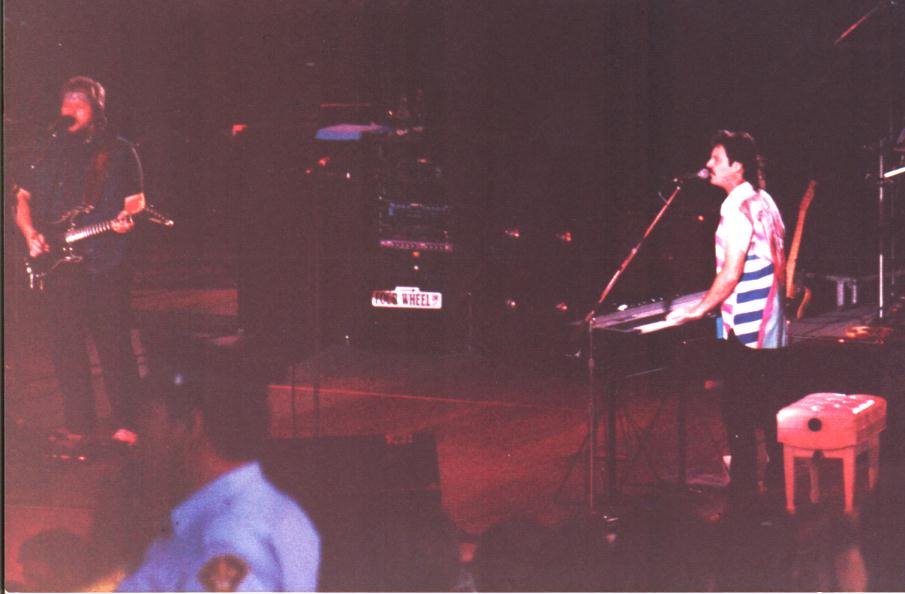
Heading to the Ontario Place/CNE area to see Randy Bachman perform You Ain't Seen Nothin' Yet, Hey You and Takin' Care of Business was, for me, like going home again. My first concert as a 12 year old budding rock fan back in 1975 was BTO at the old CNE Stadium.They were touring on Not Fragile and it cemented my burgeoning love of rock and roll as well as the guitar. A year later the same band at the same venue, this time on the strength of Four Wheel Drive, would host my second concert.

So here it is some 32 years later and I'm in the same area, this time for Bachman Cummings Overdrive at Ontario Place's Molson Amphitheatre last Thursday to re-love those early rock and roll nights, with a fair doppling of Guess Who thrown in for good measure.

Opening with American Woman 2007 the new, funkier version of the classic hit American Woman that Bachman Cummings used to close their last album, Jukebox, the set comprised eleven Guess Who numbers, four BTO and two covers fro the Bachman Cummings Jukebox. In all, seventeen songs, seventeen well known hits, 15 by the artists on stage.

If it's just hits you want there's many a bar with an unknown band playing lots of them every Friday and Saturday night. Bachman Cummings, however, are better than that. They played through the set with ease and agility, Bachman's renowned guitar playing shining through and Cummings' sharp beautiful voice still sounding great, even if it has grown nasally through the years.

Cummings' voice may, in fact, have been the shows one weakness. While he sounded fine, he shared the singing duties almost evenly with Bachman, leading one to think he may not have the vocal strength the carry an entire show any more. Since Cummings was lead singer on all those classic Guess Who songs, his solo work was completely ignored. It says a lot about these guys that they played wall to wall hits for 90 minutes and could leave songs like My Own Way to Rock, Break it to Them Gently and I'm Scared un-played. But the show would have been stronger with a few of them none the less.

I'm nitpicking: starting with American Woman 2007, which is better live than on disc, the show progressed to You Ain't Seen Nothin' Yet with Bachman showing an improved voice, to surprising audience favourite Clap For the Wolfman, complete with audience hand clap. The fun included Bachman calling for cowbell playing Cummings to give him "more cowbell" Christopher Walken style, during Hey You.

Fun is the operative word. There was nothing fancy to this night: the lights were basic, there where no fire works, no over long solos. Just two talented performers, backed by a very competent band (The Carpet Frogs) having fun. And in turn the audience had fun, which is what a concert is supposed to be about.

Friday, June 20, 2008

Bachman Cummings at Molson Amphitheatre

A full review to come, but meanwhile, here's the setlist and some pictures:


American Woman
Who Do You Love
Albert Flasher
These Eyes
You Ain't Seen Nothin' Yet
Clap For The Wolfman
Let It Ride
Hand Me Down World
No Sugar Tonight/New Mother Nature
--- Band Intros ---
Hey You
Laughing
Undone
Little Queenie
Star Baby
No Time

Encore

Share The Land
Takin' Care Of Business


Sunday, March 02, 2008

Jeff Healey 1966- 2008

I first saw Jeff Healey play on the New Music back in the early 80's. John Roberts was J.D., and he did a story on a blind teenage phenom who played blues guitar with the guitar across his lap. He cited Jimi Hendrix as an influence and played in a very Hendrix style.

Five or six years later, in 1988, Jeff Healey was on the charts with the album See The Light. It included the hit songs Confidence Man, the title track and perhaps Healey's biggest hit, a wonderful version of John Hiatt's Angel Eyes. His second album two years later, Hell To Pay, featured a stunning version of George Harrison's While My Guitar Gently Weeps. It takes a man among guitar players to tackle a classic Eric Clapton solo but Healey pulled it off.

Sadly, Jeff Healey has fought cancer all his life, losing his sight to Retinoblastoma, a rare form of cancer, at age one. Last January (2007) it was announced that Healey had had been diagnosed with lung cancer surgery the previous December, and had undergone surgery to remove the cancerous tissue.

Jeff Healey passed away last evening at St. Joseph's Hospital Toronto. He was 41 years old and leaves a wife and two children, 13-year-old daughter Rachel and three-year-old son Derek. At Home in Hespeler offers condolences to the family of Jeff Healey, a great Canadian talent gone far too young.

Thursday, July 19, 2007

Milk Crate Classic #4: Moxy II

Moxy is an relatively obscure name in Canadian music, but they needn't be. They once verged on greatness and, at a time just before an explosion of Canadian rock on the landscape, they produced a pair of great rock and roll albums. Moxy and Moxy II (known as the black and red albums respectively) were solid guitar rock albums that may be better than anything produced in the hard rock genre in Canada before or since.

Moxy II, released in 1976, contained nine tracks, a number of which belong on any album. The opening song 'Cause There's Another was probably the groups biggest hit, and a great song. It starts off in a very hard rock style, but quickly slips into acoustic guitar with melodic lead line combination that would have made April Wine proud, although it may be more reminiscent of Teenage Head's Something On My Mind (or rather, Teenage Heads... would be reminiscent of 'Cause There's Another).

There's an old saw in golf, "hit for show, putt for dough". A similar statement can be made in guitar - left hand for show, right for dough. The left hand is what people notice, the one that moves around and gets the credit, but any good guitarist can tell you, the musicality comes from the right hand. Sound, tone and rhythm are all products of the right. Listening to the acoustic guitar in 'Cause There's Another, there's some amazing stuff going on. Moxy have eschewed a basic little rhythm over something much more complex and interesting. It is musicality of the kind that moves the song from good to great, and sets the tone for a wonderful album.

Second song Take it or Leave it is solid 70's funk that predates Wild Cherry's Play that Funky Music and David Bowie's Fame, both of which sound as though they borrow from this. Take it or Leave it is, to my ear, however, superior to both those songs. Kids, this is what we danced to in the 70's and it was great dancing music.

While the albums best two songs are the first two, the rest of the album is good, very good. Through the Storm is very heavy and hard rock in the Spinal Tap vein; One More Heartbreak an up tempo rocker; Change In My Life a solid ballad laced with appregiating guitars and thick sound (Moxy was a two Les Paul band).

Lead singer Buzz Shearman would self destruct after this album, and would be replaced by Mike Reno, then known as Mike Renowski, now known as "the chubby guy who used to sing for Loverboy." They would never recapture being this good, and it's too bad: the Canadian rock and roll scene would explode within a couple of years, and if Moxy had held it together there's no reason to believe they wouldn't be mentioned in the same breath as Rush, Triumph or Loverboy. A great band who never attained that greatness - too bad.

Milk Crate Classic #5: Moxy II

Moxy is an relatively obscure name in Canadian music, but they needn't be. They once verged on greatness and, at a time just before an explosion of Canadian rock on the landscape, they produced a pair of great rock and roll albums. Moxy and Moxy II (known as the black and red albums respectively) were solid guitar rock albums that may be better than anything produced in the hard rock genre in Canada before or since.

Moxy II, released in 1976, contained nine tracks, a number of which belong on any album. The opening song 'Cause There's Another was probably the groups biggest hit, and a great song. It starts off in a very hard rock style, but quickly slips into acoustic guitar with melodic lead line combination that would have made April Wine proud, although it may be more reminiscent of Teenage Head's Something On My Mind (or rather, Teenage Heads... would be reminiscent of 'Cause There's Another).

There's an old saw in golf, "hit for show, putt for dough". A similar statement can be made in guitar - left hand for show, right for dough. The left hand is what people notice, the one that moves around and gets the credit, but any good guitarist can tell you, the musicality comes from the right hand. Sound, tone and rhythm are all products of the right. Listening to the acoustic guitar in 'Cause There's Another, there's some amazing stuff going on. Moxy have eschewed a basic little rhythm over something much more complex and interesting. It is musicality of the kind that moves the song from good to great, and sets the tone for a wonderful album.

Second song Take it or Leave it is solid 70's funk that predates Wild Cherry's Play that Funky Music and David Bowie's Fame, both of which sound as though they borrow from this. Take it or Leave it is, to my ear, however, superior to both those songs. Kids, this is what we danced to in the 70's and it was great dancing music.

While the albums best two songs are the first two, the rest of the album is good, very good. Through the Storm is very heavy and hard rock in the Spinal Tap vein; One More Heartbreak an up tempo rocker; Change In My Life a solid ballad laced with appregiating guitars and thick sound (Moxy was a two Les Paul band).

Lead singer Buzz Shearman would self destruct after this album, and would be replaced by Mike Reno, then known as Mike Renowski, now known as "the chubby guy who used to sing for Loverboy." They would never recapture being this good, and it's too bad: the Canadian rock and roll scene would explode within a couple of years, and if Moxy had held it together there's no reason to believe they wouldn't be mentioned in the same breath as Rush, Triumph or Loverboy. A great band who never attained that greatness - too bad.

Wednesday, June 13, 2007

CD Review: Bachman-Cummings Jukebox

Bachman Cummings new CD, Jukebox, hit the stores yesterday morning. The CD is a collection of older material, "a new album of old songs," songs that Messrs Bachman and Cummings would have heard on the jukeboxes in their youth. This is the music these two legends began their career playing, and the album pays homage to the songs they loved.

The concern when producing such an album is to pick the right songs, the songs that work best for your voice and band. Rush did an excellent job of this in their 2005 collection Feedback. It is also where Jukebox falls down.

Opening track , The Equals Baby Come Back, starts promising enough, with Bachman establishing a solid groove. Unfortunately, and inexplicably, Bachman also takes vocal duties. It is a weak effort, that Cummings almost certainly could have done much better. The song needed it.

Who do You Love fares better. Bachman's vocals are better suited, drummer Sean Fitzsimons takes the classic Bo Diddley rhythm to new heights, and the insertion of Bo Diddley and Don't Fade Away into the song is effective and fun.

Here's a quote from the liner notes:
To go through the Beatles songs and try to find one that hasn't been done and done adn done by eveybody was really hard.
Be that as it may, some songs stay Undone for a reason, and based on this jazzed up arrangement I'm Happy Just to dance With You, is one of them.

Whenever I hear a cover, whether a CD's worth or a single song, I'm looking for the band to own the song. Jimmy McCracklin's The Walk, is the first song on Jukebox that Bachman Cummings own. Not coincidentally, it's the first Cummings vocal vehicle. This version could be an original Burton Cummings song, which is what I'm looking for. The boys capture a great groove, and Cummings sings the song note perfect. Great rock and roll.

The same applies to Cliff Richard's Don't Talk to Him. A great rockabilly piece that, again, could be a Cummings original. In the liner notes Cummings writes that this is a tough song to sing and he was sweating it, but he did a great job, and it's a great piece.

The Shadows were Cliff Richards back up band, but they also had a string of instrumental hits on their own, and became highly influential in guitarist circles. Thankfully, their bad surf movie guitar songs went out of style 45 years ago. Sadly, Bachman resurrects "Man of Mystery" thus showing this style as worthy of going out of style.

Fats Domino's Ain't That just Like A Woman on the other hand sounds fresh and great. Cummings boogie-woogie piano and vocals make this sound fresh and new. And kudos to Bachman quoting Glenn Miller's Chatanooga Choo-Choo in his short solo.

If they were worried about using an overdone Beatles song, Chuck Berry's Little Queenie is a curious choice, considering how often it's been done, and better. Both Bob Seger and REO Speedwagon have live versions of this song that are great, giving new energy and life to Chuck Berry's classic boogie/blues playing. This version goes back to the Chuck Berry version, and suffers from a lack of that power and energy that others have found there.

Sam Cooke's Good Times is a great song that suffers, this time from Cummings vocal performance. Some songs just don't suit some singers, this is one that Cummings should have left off this album for that reason. Nicely done, just doesn't work here.

The surprise of the album is probably the downright punkish/Wild Thing version of Bob Dylan's Like a Rolling Stone, with Randy Bachman's best vocal performance of the album and a Neil Youngish solo.

John Fred and the Playboys' Judy in Diguise (With Glasses), is a classic R&B tune that here sounds great. Huey "Piano" Smith's Boogie Woogie Don't You Just Know It, is one of those 50's childish style tings, like Charlie Brown or See You Later Alligator. It sounds OK, but it should have stayed in the50's.

Georgie Fame's Yeh, Yeh is just a good old Rock and Roll song as is Edwin Starr's Agent Double-O Soul. Both songs sound good and are carried well.

The Box Tops' classic The Letter is given a BTO style rock up and works very well, as should be expected when Randy Bachman BTO's a song. IN fact, BTO demoed this song in 1971 , and released itin 1993 Anthology CD, and this version sounds more like BTO than the early BTO version did. Kudos again to drummer Sean Fitzsimons who gave some Robbie Bachman like tom-tom work to drive this song forward.

What a collection of 50's and 60's rock and roll songs would be without some Elvis, I don't know and fortunately, I don't have to find out quite yet. Ain't That loving You Baby is the kind of thing you expect on a tribute album by some guys who profess deep love for the music their doing - a song they sound like their having real fun playing. You can almost hear the swing in Burton Cummings hips, and Bachman gives some great rockabilly licks throughout. This is a real treat, sounding honestly like Elvis while giving a fresh modern sound.

The CD finishes with a cover of a song written by some guys called Bachman and Cummings. American Woman 2007 isn't really new, as this re-working was done for their last tour, and can be heard on the last years DVD "First Time Around." As well there is an acoustic version of the same arrangement floating around. None the less, this is a good work up of the song, it sounds great on Bachman's 57 Les Paul and it is interesting and new without hurting the original song. A great finish to a very good CD.

Overall, some performances here lacked, and some song choices where suspect, but this is a good CD. If you are a fan of Bachman Cummings, or of the old rock and roll, you probably want it.

4 out of 5